


L'équipe Texto SMS Gratuit
6 October 2026 · 11 min read
Introduction: "99% of the population covered" — and zero bars in your living room
France's four carriers all claim roughly the same thing: more than 99% of the population covered by 4G, 5G available in thousands of towns, green maps from north to south. On paper, then, choosing a plan comes down to price and data allowance.
In reality, two neighbours on opposite sides of the street don't get the same network. A floor, which way a façade points, a hill, a new building going up between you and the mast: the difference plays out at that scale. And since a mobile plan is an expense of €120 to €400 a year, picking the carrier that doesn't reach your home is a costly mistake — especially when you made it to save €4 a month.
This guide lays out a practical method, in three increasingly precise levels, for working out which of the four networks genuinely works at your address, at your workplace and along your daily commute. Allow fifteen minutes for the first two levels, and about ten euros for the third if you want absolute certainty.
First, understand this: there are only four networks in France
That's the starting point many people miss. Some twenty mobile plan brands exist in France, but they all run on four physical infrastructures:
| Physical network | Brands that use it (main ones) |
|---|---|
| Orange | Orange, Sosh, and some offers from certain MVNOs |
| SFR | SFR, RED by SFR, La Poste Mobile, Prixtel (multi-network), Auchan Telecom |
| Bouygues Telecom | Bouygues, B&YOU, Crédit Mutuel Mobile, Lebara (depending on the offer) |
| Free Mobile | Free, Veepee Mobile, plus partial Orange roaming on residual 2G/3G |
The direct consequence: if Orange has poor signal at your place, Sosh will too. And conversely, a €7 plan from a virtual operator riding on the Orange network gives you exactly the same coverage as a €35 Orange subscription. Coverage isn't a question of price, it's a question of network.
A second important nuance: virtual operators (MVNOs) aren't always given absolute priority. When a mast is heavily congested, some wholesale contracts allow for lower prioritisation. That isn't a coverage block, but it can translate into slower speeds at peak times, in a railway station or a stadium.
Level 1: the official maps, and how to read them without being misled
The source to favour: monreseaumobile.arcep.fr
The maps published by the carriers themselves are marketing maps. The independent reference is "Mon réseau mobile", the service run by ARCEP (the French regulator for electronic communications, postal services and press distribution). It aggregates the maps declared by the carriers — verified through the regulator's own measurement campaigns — and displays them side by side for all four networks.
Three settings to adjust every time:
- Choose the right coverage type. The site distinguishes voice/SMS from mobile internet, and the levels "very good", "good" and "limited". A zone shown as "limited" coverage means, in practice: it works outdoors, standing still. Not indoors.
- Display all four carriers one after another for the same address, not just the one you're interested in.
- Look at 4G before 5G. 5G doesn't improve range: on the 3.5 GHz bands, it penetrates buildings less well than 4G on 700 MHz. A home with poor 4G coverage won't be rescued by 5G.
The maps' blind spot: inside buildings
Coverage maps are calculated for outdoor reception. ARCEP is explicit on this point: the levels shown correspond to use outside buildings, and indoor coverage can be appreciably degraded.
That's precisely the gap most disappointments fall into. Recent or renovated buildings — external insulation, metal-coated glazing, reinforced concrete, cladding — attenuate the signal heavily. A home rated A on the French energy performance certificate is often a partial Faraday cage. Hence the absolute need for level 2.
White zones and newly built masts
ARCEP also publishes progress tracking for the New Deal Mobile, the 2018 agreement imposing deployment obligations on carriers, notably shared sites in poorly covered areas. If you live in a rural municipality, check the ARCEP site to see whether a site is planned or being brought into service: that radically changes the decision over a six-month horizon.
Level 2: measure it yourself, with hard numbers
The signal bars shown at the top of your screen are the manufacturer's own free interpretation: three bars on an iPhone and three bars on a Samsung don't correspond to the same signal. To make a serious comparison, you need the raw value.
The right unit: dBm
Signal level is read in dBm (decibel-milliwatt), a negative value: the closer it is to zero, the better.
| Measured value | What it really means |
|---|---|
| −50 to −75 dBm | Excellent: high speeds, stable calls |
| −75 to −90 dBm | Good: normal use, no problems |
| −90 to −105 dBm | Average: slow browsing, calls that sometimes drop |
| −105 to −115 dBm | Weak: SMS yes, data very difficult |
| Below −115 dBm | Practically unusable |
Where to find that value
- On Android: Settings → About phone → Status / SIM information. There you'll find "Signal strength" and often the RSRP on 4G/5G.
- On iPhone: the legacy diagnostic mode (
*3001#12345#*) has been restricted depending on the iOS version. Failing that, network measurement apps display the signal level and let you log a history.
The 15-minute protocol
Walk through your home with a notepad, or better still: a measurement app that timestamps your readings. For each room where you actually use your phone, note:
- The level in dBm.
- The technology displayed (4G, 4G+, 5G — and definitely not "E" or "H+").
- A speed test, download and upload, three times in a row, at three points in the day (morning, 1 p.m., 8 p.m. — peak network hours in France fall between 7 p.m. and 10 p.m.).
- A real two-minute call to someone who'll tell you honestly whether they can hear you.
Point 3 is the one people skip and the one you absolutely must keep. A mast can deliver an excellent signal and mediocre speeds because it's saturated at the very hours you're at home. Signal measures your distance from the mast; throughput measures how many neighbours are on it.

In homes where the difference between two rooms is enormous, also note the phone's position when you measure: behind metallised glazing, the signal can gain 15 dBm if you move a metre to one side. A simple adjustable phone stand placed near the window in your office is sometimes enough to transform video-call quality, without buying anything else.
Level 3: field testing with a prepaid SIM
This is the only method that gives you certainty. It involves physically testing the rival network before you cancel.
The principle
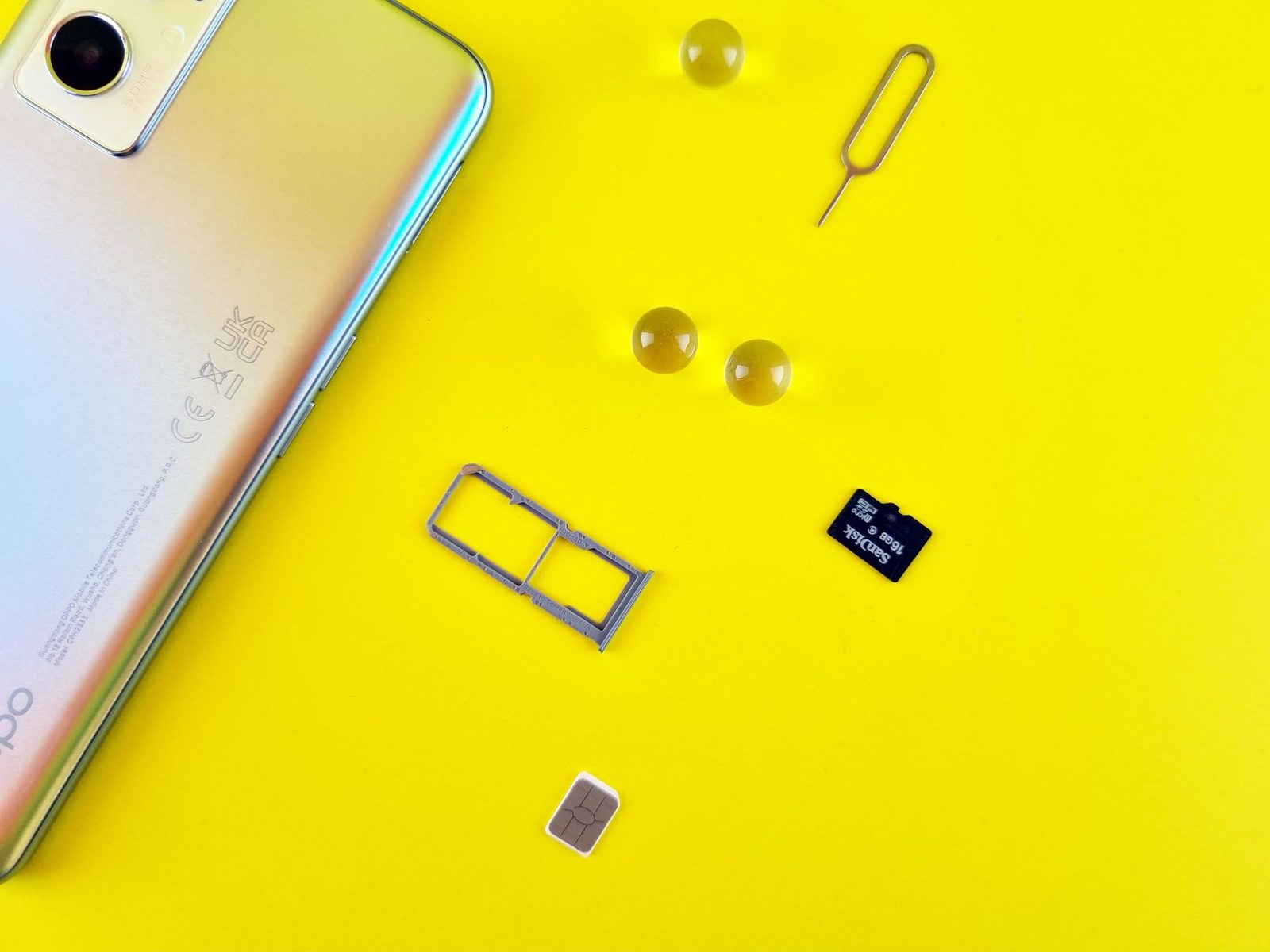
Get hold of a prepaid SIM card or a cheap no-commitment plan from the carrier you're considering (Orange, SFR, Bouygues or Free). Budget €5 to €15 for a handful of gigabytes valid for several weeks. Put it in a second SIM slot or an old phone, and run the level 2 protocol again: home, office, commute.
Two practical variants:
- Dual SIM: if your phone accepts two SIMs (physical + eSIM, or two physical), you can test the competitor without touching your main line. A great many models sold in France since 2021 support eSIM, which makes buying a test plan instantaneous.
- Test phone: an old carrier-unlocked smartphone, even one from five years ago, does the job perfectly well for measuring 4G. One caveat, though: an older device doesn't handle the same frequency bands as a recent model and may underestimate the real coverage.
What this test reveals — and nothing else does
- Reception inside your home, in numbers.
- Behaviour at peak times on your mast.
- Real voice quality, including over VoLTE.
- Coverage along your commute, often the real blind spot: a regional rail line or a stretch of motorway with poor coverage ruins an hour of your day, twice a day.
If your commute is long, measure it on the move over several days. And while you're at it: a pair of noise-cancelling wireless earbuds improves perceived call quality on a train more than switching carriers does, because a good share of the "dropouts" you hear are actually ambient noise drowning out the voice.
The four mistakes that skew every test
Testing with a phone that doesn't support the right bands
The four carriers don't exploit the same frequencies in the same way. A smartphone imported from outside the European Union, or an older entry-level model, may not support the 700 MHz band (B28) — the most useful one indoors and in rural areas. You'll conclude that the carrier has poor signal when in fact it's the device that's deaf. Check your model's spec sheet before passing judgement.
Confusing "no network" with "3G switched off"
3G networks have been progressively shut down in France from 2025 onwards, carrier by carrier, after 2G at some of them. If your phone is old and doesn't support VoLTE (voice over 4G), it can end up with no service for calls even though data works. The problem isn't coverage: it's compatibility.
Measuring only once
A single reading is worthless. The mobile network is a shared resource: how it behaves at 11 a.m. on a Tuesday bears no relation to Sunday at 8 p.m. Three readings minimum, at three different times.
Forgetting the case and your hand
A thick flip case with a metal plate, a badly positioned magnetic mount, or simply where your hand sits along the bottom edge of the device can cost you several dBm. If you're borderline, a slim soft silicone case sometimes changes the outcome of a call. This isn't a myth: attenuation caused by the hand has been documented since the earliest smartphones.
Improving what can be improved, without switching carriers
Before concluding that you need to leave, three free or low-cost levers:
- Turn on Wi-Fi calling (VoWiFi) in your settings. Voice travels over your router, and mobile coverage becomes secondary for calls at home. It's the most effective solution, and it costs nothing.
- Force the network mode to 4G rather than "5G automatic" when 5G is unstable where you live: the phone stops constantly switching between two networks, which stabilises calls and saves battery.
- Reposition the router and the Wi-Fi access point if it's actually Wi-Fi that's faltering as well. A mesh Wi-Fi extender placed halfway between the router and the dead-zone room solves more problems than changing plans, provided VoWiFi is switched on.

Mobile signal boosters sold online — "GSM boosters" — are banned in France for use by the general public without authorisation. ANFR (the national frequency agency) regularly points out that using them carries the risk of penalties, because they disrupt the network for the entire neighbourhood. The only legal signal-repeating solutions go through a device supplied or approved by your carrier.
The final decision grid
Lay your readings side by side and settle it with three questions:
- Do calls hold up at home? If yes, even with an average signal, and if VoWiFi works, coverage isn't your problem: optimise for price.
- Do speeds collapse between 7 p.m. and 10 p.m.? If yes, the mast is saturated. Another carrier, even one with a weaker measured signal, may do far better. This is exactly the case where a level 3 test pays off.
- Is my daily commute covered? If you spend an hour a day in a network tunnel, no amount of extra gigabytes will make up for it.
And once the decision is made: you switch while keeping your number, via your RIO code, within a few working days — with no need to go through your old carrier's customer service. Just keep the test SIM active for a few weeks after the switch: it's your safety net if everyday reality differs from your fifteen minutes of measurements.
Further reading
- ARCEP — Mon réseau mobile: comparative coverage maps for the four carriers and results from the annual measurement campaigns on mobile quality of service.
- ARCEP — Observatoire du New Deal Mobile: tracking of new mobile sites deployed in poorly covered areas.
- ANFR: Cartoradio, the public map of authorised mobile masts, to find out which mast actually serves you and at what distance, plus regulatory reminders about signal boosters.